
Pumper Fire Truck Selection: Why Pump Flow and Tank Size Mismatches Surface at the First Live Fire
Departments often open a pumper purchase with the choices everyone can see: cab style, paint, seating, price. Those affect daily comfort and public image, but they don’t decide whether the truck can move water when it counts. Pump flow and tank size do, and both belong near the front of the spec discussion.
Pump flow is the gallons per minute an apparatus can deliver to attack lines, master streams, and relay operations. Tank size is how long that flow can last before a water source is connected. A mismatch between the two is easy to miss during a demo or an inspection, because on paper every number still looks right.
When pump flow exceeds what the tank can support, the booster tank runs dry in a minute or two and the crew waits on a water source that may be slow or missing. When the tank is oversized for the pump, the truck carries extra weight and cost without gaining usable firepower. Reviewing how Zoomlion builds its fire apparatus is one way to see how those two figures are balanced on a real build.
How Pump Flow and Tank Size Interact on a Pumper
Rated pump capacity and tank capacity are separate specifications, and they behave differently at a fire. Fire pump capacity, or the pump flow rating, is the maximum volume the pump can discharge per minute (GPM or LPM). Water tank capacity (gallons or liters) is a fixed reserve that feeds the pump until a permanent supply is hooked up. On a fire engine, one number sets the delivery rate and the other sets how long that rate can hold.
Pump flow rating sets the delivery rate
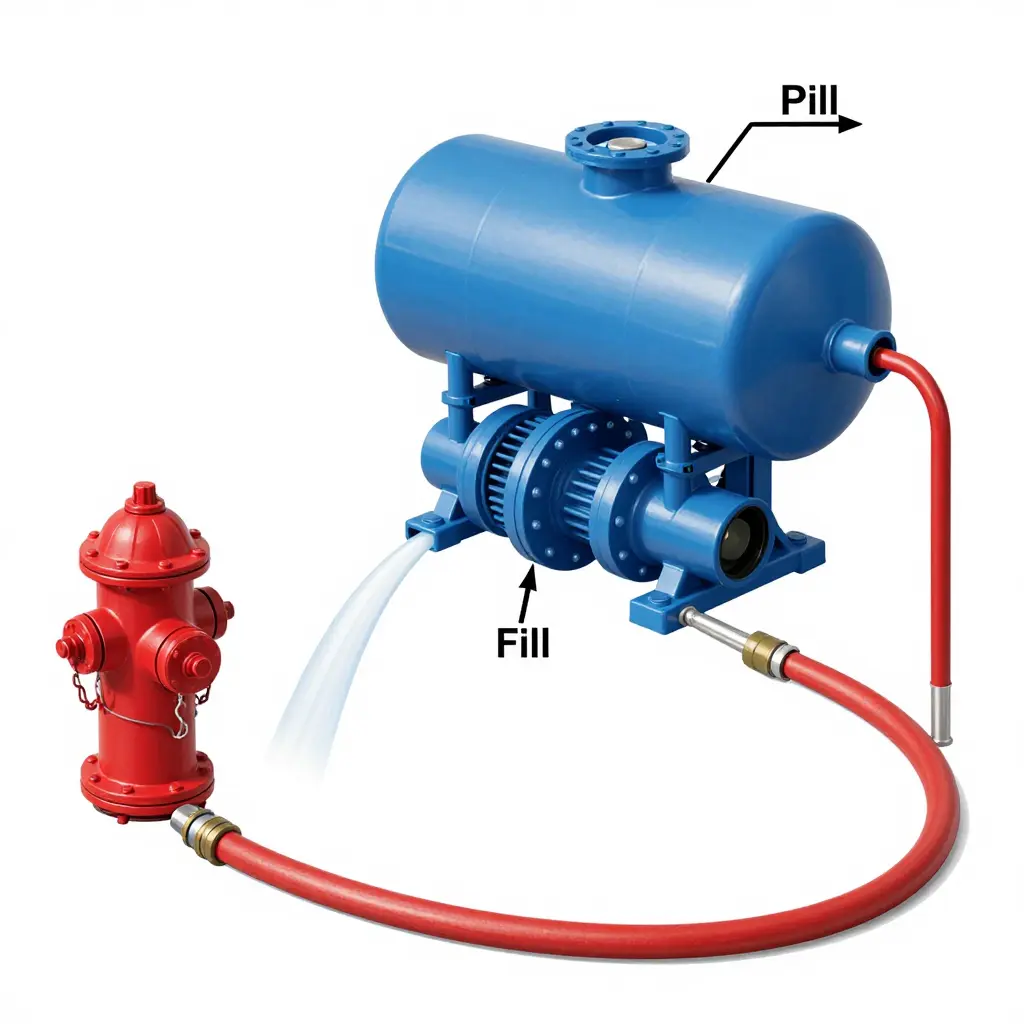
A pump doesn’t create water; it moves it. Open a booster line or handline and the pump pulls from the onboard tank through the tank-to-pump line and pushes water to the nozzle. Flow in the line equals what leaves the nozzle, so a higher pump flow rating lets more attack lines run at rated pressure at the same time.
Tank size sets the operating duration
The tank holds a fixed volume, so pump flow decides how fast it empties:
Tank duration = tank volume / pump flow rate
A 1,000-gallon (3,785 L) tank feeding one 200 GPM (760 LPM) handline lasts about five minutes. Add a second line or open the nozzle wider and that window shrinks in proportion.
The pump continues only with an established supply
The pump can only discharge while water is available. Once the tank is dry, it has to draw from a hydrant, a water tender running a shuttle, or a static source through a draft connection. Until one of those is secured, the pump is limited to whatever the tank holds, which is what makes a booster line or handline a short-duration tool without a supply line behind it.
Matching the two ratings
Pump flow and tank size should match the calls a department actually runs. A large pump on a small tank exhausts quickly; a large tank behind a low-flow pump gives long but limited suppression. Departments reviewing a fire engine truck for sale should size the tank around how long it takes to establish a supply and size the pump around the attack lines they expect to deploy on arrival.
| Pumper Class | Rated Pump Flow (GPM) | Onboard Water Tank (Gallons) | Recommended Use Case | Common Mismatch Risk |
|---|---|---|---|---|
| Mini / Urban Pumper | 500 – 750 | 200 – 500 | Narrow streets, parking structures, quick hit on small room-and-contents fires | Tiny tank empties in under a minute, forcing an early water shuttle |
| Standard Structural Pumper | 1,000 – 1,500 | 500 – 1,000 | Everyday municipal structural firefighting with hydrant support | Big pump drinks the tank dry faster than crews expect before a hydrant is charged |
| Attack Pumper | 750 – 1,250 | 300 – 750 | First-arriving rapid attack and fast knockdown before backup arrives | Aggressive flow outruns the tank, cutting attack time short |
| Rural / Tanker-Pumper | 500 – 1,000 | 1,000 – 2,500 | Areas without hydrants relying on water shuttle operations | Large tank paired with a modest pump refills slowly and stalls the shuttle |
| Industrial / High-Flow Pumper | 1,500 – 3,000 | 500 – 1,500 | Refineries, tank farms, and high-volume defensive operations | Enormous flow capacity overwhelms the small onboard reserve and supply line |
Common Pump Flow and Tank Size Mismatches
Most underperforming pumpers don’t fail because one part is bad. They fail because two specs that looked fine on their own pages don’t work together on the same truck.
- High-flow pump, small tank: the pump outruns the water behind it, so the tank is empty in under two minutes and the crew is left waiting on a hydrant that may not exist.
- Large tank, undersized pump: there is plenty of stored water, but the pump can’t move it fast enough to feed the attack lines, so the reserve sits unused.
- High-pressure pump, piping or nozzles that can’t carry it: pressure shows at the panel but is lost through undersized piping, so the stream at the tip never matches the rating.
- Tank water treated as a full response without a supply line: the build counts on the tank alone, as if a rural or highway fire will be refilled quickly. It won’t.
- A full tank eating into chassis payload: every gallon displaces hose, tools, and crew, so a truck that looks capable on the spec sheet shows up light on equipment.
- A pump flow rating taken under ideal draft conditions, then fed by an intake that chokes on the real supply — a low-pressure hydrant or a long relay.
- A foam or compressed-air system sized to the pump’s peak output instead of its practical operating range, so capacity is paid for that never reaches the nozzle.
The pattern repeats: the truck looks capable on paper, passes inspection, and then underperforms on the first live fire, when flow, duration, and pressure all matter at once. Treating the pumper spec as one system rather than a list of numbers is what prevents that outcome. A skilled custom fire truck builder will match pump flow, tank size, and chassis capacity together before the order is finalized.
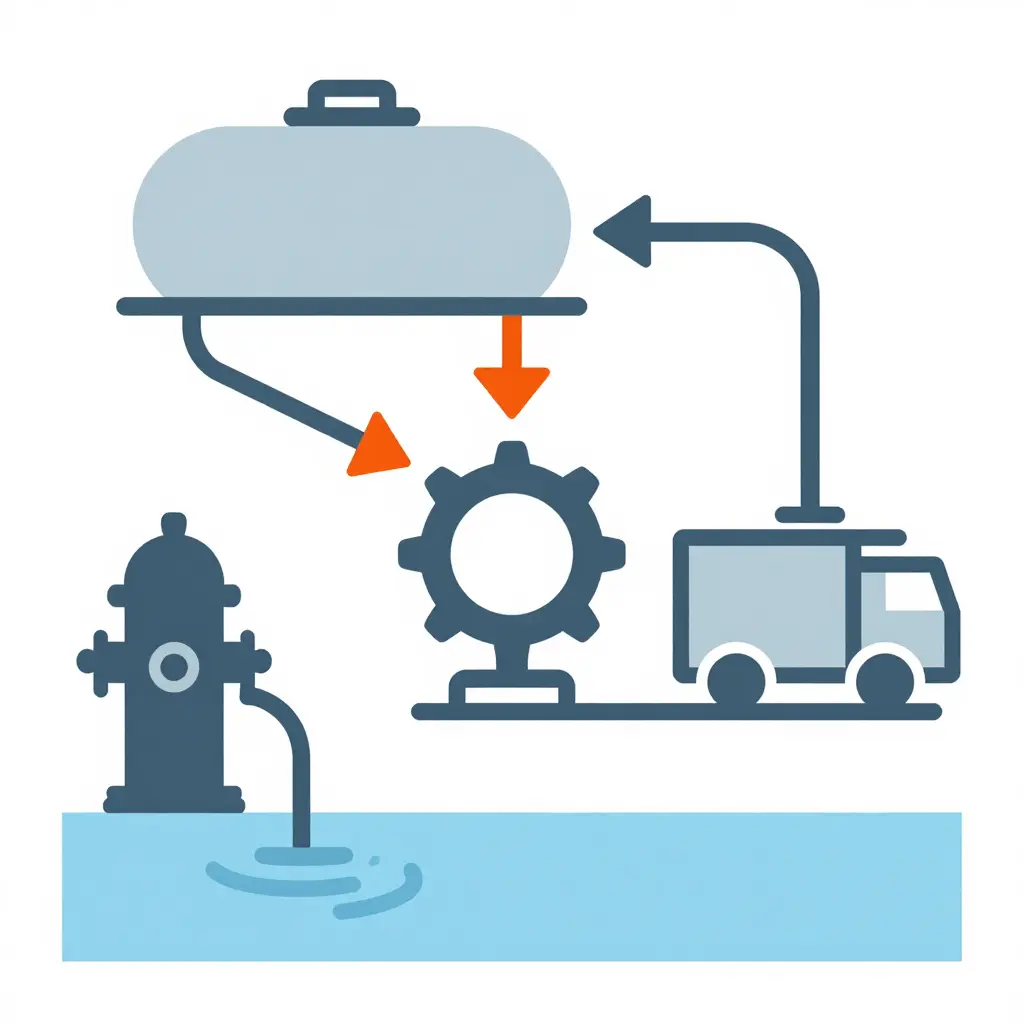
How Mismatches Surface at the First Live Fire
A live fire is the first time the relationship between pump flow, tank size, and fire pump capacity can be measured instead of estimated. When the three are out of balance, the effects show up in the first minutes of the attack, before a sustained supply is in place.
The most common failure is running the tank out before a supply line is established. If pump flow is high relative to the water carried, the tank hits its residual level within minutes, and the pump loses supply right as the attack line is being advanced. The crew sees pressure fall at the pump discharge, then water stop at the nozzle.
Another failure is a pump that can’t hold its rated output. A pumper rated at a given fire pump capacity may only reach that flow under ideal conditions. Drafting, or working from a hydrant with weak residual pressure, can pull it below the rated pump flow, and discharge pressure becomes unstable. Operators often compensate by backing off the throttle, which lowers the flow that actually reaches the fire.
A third effect is weight. An oversized tank raises gross vehicle weight and eats into the allowance for equipment, hose, and personnel, which can cut the hose carried and the water applied at once.
On the fireground these mismatches show up as pressure loss, water that comes and goes at the nozzle, and a switch to a secondary water source earlier than planned. Teams should evaluate pump flow, tank size, and fire pump capacity as one matched system, and when comparing real apparatus options such as a fire truck for sale, favor a configuration that holds its rated performance under real conditions.
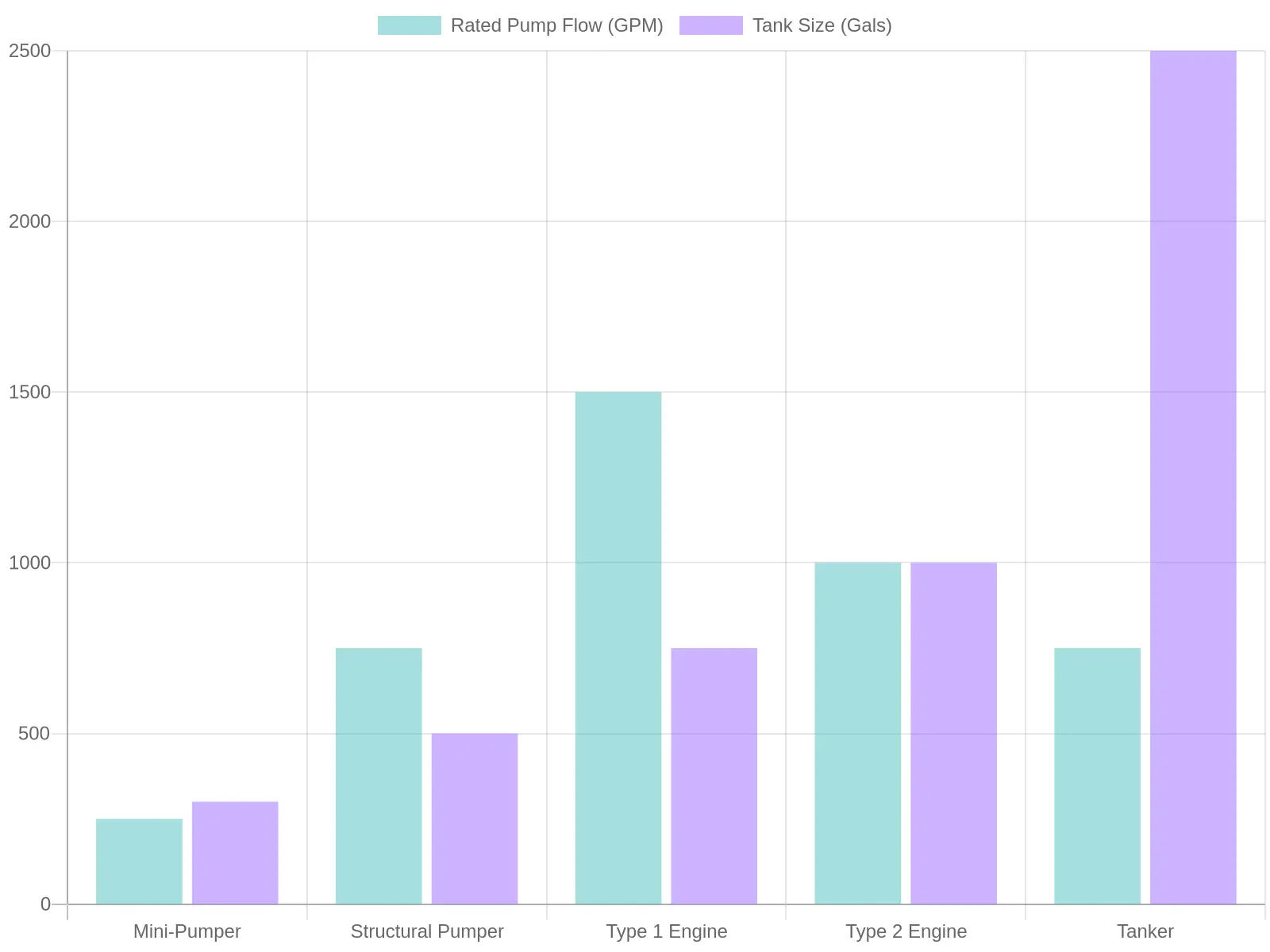
Pump Flow vs. Tank Size Across Pumper Classes – Grouped bars compare rated pump flow (GPM) against onboard water tank capacity (gallons) for five pumper classes, showing where a high-flow pump pairs with a small tank (Type 1 Engine) and a large tank pairs with a low-flow pump (Tanker).
Selecting a Pumper: Matching Pump Flow to Tank Size
Pumper selection comes down to one relationship: whether the tank size behind the pump can sustain the flow the nozzles demand. Treat pump and tank as one decision, not two separate specifications. A truck that meets its pump rating but drains its tank in under two minutes is not a working pumper. The aim is to match expected flow demand to onboard water so a crew can hold a sustained attack or bridge to a supply without losing the line.
Step 1: Establish the expected flow demand
Start with the nozzles and lines you plan to deploy, not the average call.
- Single 1.75-inch handline: typically 100-200 gpm.
- Multiple attack lines: add each line. Two 200 gpm handlines plus a 500 gpm master stream equals roughly 900 gpm.
- Master stream or deck gun: 500-1,000+ gpm depending on nozzle and operating pressure.
Record the realistic worst-case flow. That number, not the typical flow, sets the minimum requirement.
Step 2: Calculate how long the tank will last
Divide usable tank volume by the flow demand to get minutes of operation.
Formula: endurance (minutes) = usable tank volume (gallons) / flow demand (gpm)
| Usable tank | Flow demand | Endurance |
|---|---|---|
| 500 gal | 500 gpm | 1.0 min |
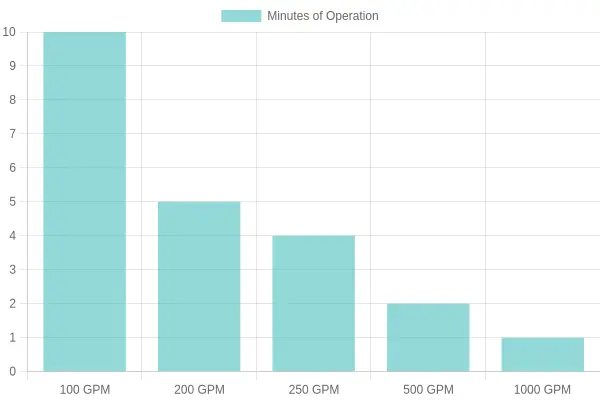
| 750 gal | 250 gpm | 3.0 min |
| 1,000 gal | 250 gpm | 4.0 min |
| 1,000 gal | 500 gpm | 2.0 min |
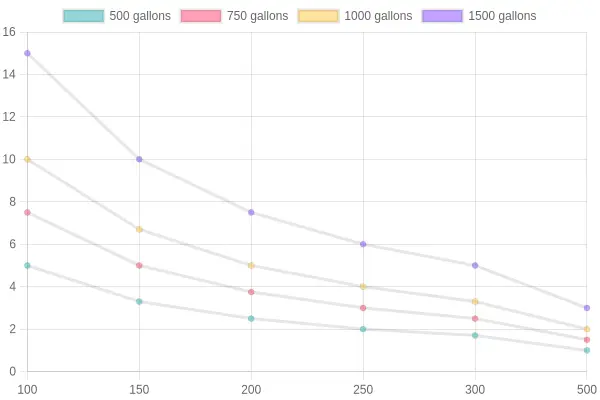
If endurance at full attack flow is under roughly two minutes, the pumper depends entirely on a fast water supply. The chart below shows how endurance falls as flow rises across common tank sizes.
Step 3: Choose the fix – tank, pump, or supply plan
With demand and endurance known, pick the lever that corrects the mismatch:
- Larger tank: adds endurance where no hydrant exists or the tender shuttle is slow.
- Higher-rated pump (fire pump capacity): required when needed flow exceeds the current rating at the actual discharge pressure.
- Rapid water supply plan: acceptable when hydrants, tenders, or relay pumping can refill the tank quickly.
Reading pump flow ratings correctly
Pump ratings are pressure-dependent and should not be read as a single number.
- A “1,000 gpm” pump often reaches that flow only at low pressure, frequently around 150 psi.
- The same pump delivers less flow at higher pressures such as 250 psi.
- Request the pump curve showing flow at 150, 200, and 250 psi before accepting any rating.
Verify usable tank volume versus nominal volume
Nominal tank size is not the water you can actually use.
- Nominal rating: total shell volume.
- Usable volume: nominal minus reserve for baffles, foam concentrate, and the bottom reserve the pump cannot draw.
- Usable volume often runs 85-95 percent of nominal.
Ask the fire truck manufacturer for both figures in writing. A reliable manufacturer supplies pump curves and usable volume data as standard documentation. If you compare fire trucks for sale, request the engineering sheet first, because listing pages rarely show pressure-dependent flow or usable gallons.
Frequently Asked Questions
What is a normal tank size for a pumper fire truck?
Most municipal pumper fire trucks carry an onboard water tank between 500 and 1,000 gallons, with 750 gallons a common baseline for departments that rely on hydrants for sustained supply. Rural and suburban departments that frequently operate beyond water mains often spec tanks of 1,000 to 1,500 gallons to extend the initial attack window. The right tank size depends on whether the pumper is expected to fight the fire alone for the first few minutes or to anchor a tanker shuttle. Larger tanks and the pumps to match them both add to chassis weight and budget, so before ordering it also helps to understand how much a fire truck costs.
How is pump flow rating measured?
The fire pump capacity of a pumper is rated in gallons per minute (GPM) at a specific pressure, measured during the NFPA 1901 acceptance test at 100 percent and 70 percent of rated capacity. A pump rated at 1,500 GPM must actually deliver that flow at 150 PSI, hold 70 percent of it at 200 PSI, and hold 50 percent at 250 PSI. Those checkpoints matter because a pump that looks strong on paper can fall short once multiple attack lines and a deck gun are flowing at once.
Why does a large tank need a matching pump?
A big tank does little for an aggressive interior attack if the pump flow cannot move water fast enough to supply several hose lines at working pressure. When the pump is undersized relative to the tank, crews empty the reserve quickly while the pump struggles to keep up, which erodes the advantage the extra water was meant to provide. Matching the pump rating, tank size, and plumbing diameter keeps discharge pressure stable so the water in the tank actually reaches the fire.
How can a department tell if pump flow and tank size are mismatched?
A clear warning sign is when the tank drains far faster than the pump can keep up during routine drills, or when pressure sags noticeably as soon as a second or third line is opened. Departments can also compare the rated GPM against the tank volume and the expected number of simultaneous lines, then verify results through a live-flow test rather than relying on spec sheets. If the pump cannot sustain the rated flow while supplying the tank and hydrant intake together, the two components are out of balance.
Does a larger water tank always improve firefighting performance?
No. A larger tank only helps when the fire pump capacity and the rest of the apparatus can support it. Extra water adds weight that can reduce payload for equipment, raise the center of gravity, and increase stopping distance, while an unmatched pump may still deliver weak pressure. The goal is a balanced pumper fire truck, where tank size, pump flow, hose layout, and chassis rating are engineered to work together for the missions the department actually runs.
Key Takeaways for Pumper Fire Truck Selection
Pump flow and tank size are not independent specifications to be maximized in isolation. Each has to be balanced against the department’s expected flow demand and its actual water supply plan. A high-rated pump paired with a small tank still runs dry before a sustained attack line or master stream can be supported, while an oversized tank can reduce usable payload and exceed what the chassis is rated to carry. These imbalances rarely appear during routine inspections; they surface at the first live fire, when flow demand, hydrant capacity, and tanker shuttles are tested together under real conditions.
Before purchase, verify three figures: the pump’s rated flow at a defined pressure, the tank’s usable volume rather than its nominal capacity, and the chassis payload after all equipment and water weight are added. Checking those against fill-site distances, hydrant availability, and mutual-aid response times closes the gap between a specification sheet and field performance.
As a fire truck manufacturer with over 30 years of experience, ZOOMLION supplies diversified fire-fighting vehicles to global clients, including aerial-platform and aerial-ladder fire trucks alongside its pumper and tanker lines. Departments weighing configuration against budget can review typical fire truck pricing factors to align pump flow, tank size, and chassis selection with operational requirements.