
The Real Ladder Truck Cost: Why an Aerial Apparatus Is a 20-Year Capital Decision
It’s a Tuesday night budget meeting in a mid-sized city, and the committee is doing the math one more time. On the table sit two competing requests: the school district’s roof replacement and a line item from the fire chief for one new aerial ladder truck. Someone reads the estimate aloud, and the figure stacks up against a small municipal building. A council member asks the question that has stalled so many apparatus requests: can we really justify this in one budget cycle? Across town, a 26-year-old ladder truck is running up repair bills that have already crossed into six figures. The city has been paying for that truck all along.
Ladder truck cost is where that tension plays out. An aerial apparatus does not fit a routine fleet-replacement schedule like a pickup truck; it is a capital commitment built to serve 20 years or more of high-rise rescues, ventilation, and elevated master-stream operations. It is custom-built, delivered on long lead times, and bound by public safety regulations. Price it like an ordinary vehicle and the numbers will mislead you.
Start with what drives the price: chassis, aerial device, pump systems, customization, and compliance. From there, we get into realistic price ranges and the total cost of ownership across the truck’s service life. If you have been benchmarking against simpler apparatus, it helps to first understand how much does a fire truck cost and how fire truck cost differs across apparatus classes. The biggest single factor comes first: what drives the price of a ladder truck.
What Actually Drives Ladder Truck Cost
A ladder truck’s price is the sum of dozens of engineering decisions made at the spec table, and the gap between a lean build and a loaded one is wide. Marietta, Ohio took delivery of a new ladder truck for about $1.7 million, and industry reporting suggests the same apparatus ordered today would run $2 million to $2.5 million. Your department’s number falls somewhere in that range, and the choices below are what move it.
- Aerial reach and height – A 75-foot aerial is the affordable baseline. Moving to a 100- or 107-foot device adds larger booms, heavier outriggers, and stronger hydraulics, and the price jumps with them. Spec only the height your tallest structures require, and this line stays in check.
- Chassis type (custom vs. commercial) – A commercial chassis keeps cab and drivetrain costs down. A custom chassis buys cab room and layout flexibility, but it can add well into six figures before the body is even mounted.
- Rear-mount vs. mid-mount vs. tiller configuration – Rear-mount is the most common and the most cost-effective. Mid-mount improves maneuverability for a premium. A tiller adds a second driver position and a rear-steering axle, which puts it at the top of the price range.
- Pump and water-tank specifications – A 2,000 gpm pump and a large tank, like the setup on the Dubuque ladder truck, cost far more than a modest 1,250-1,500 gpm package. Every extra gallon of capacity adds weight, structure, and money.
- Construction materials (steel vs. aluminum) – Steel costs less upfront but is heavier and more corrosion-prone. Aluminum and stainless bodies cost more to buy and less to maintain, which shifts spending from the capital budget to the operating budget.
- Electronics and communication systems – CAD-integrated displays, telematics, and radio interoperability packages add tens of thousands upfront, plus licensing and software costs that keep coming afterward.
- Body customization – Custom compartments, tool mounting, and onboard generators built around your equipment add cost quickly. Standardizing layouts with a neighboring department can bring that back down.
- Safety and NFPA systems – NFPA-compliant seating, airbags, rollover protection, and advanced warning-light packages are largely non-negotiable, and they make up a growing share of the total price.
None of these are fixed costs of doing business. Aerial height, chassis, mounting style, and equipment specs all live on the spec sheet, which is the one place a city has genuine leverage. Understand the levers and you can right-size the spec instead of paying for capability your crews may never use. Working with a specialist custom fire truck builder early in the process is the surest way to keep the final number defensible.
New, Used, or Refurbished? Choosing Your Next Aerial Ladder Truck
Every municipal ladder truck purchase comes down to one honest question: how do you get a safe, reliable aerial into service without wrecking the budget? There are three realistic paths, and each trades money against risk in a different way. Which one fits depends on your call volume, your reserve fleet, and how soon you need the rig on the street.
Buying New: Maximum Safety, Maximum Price
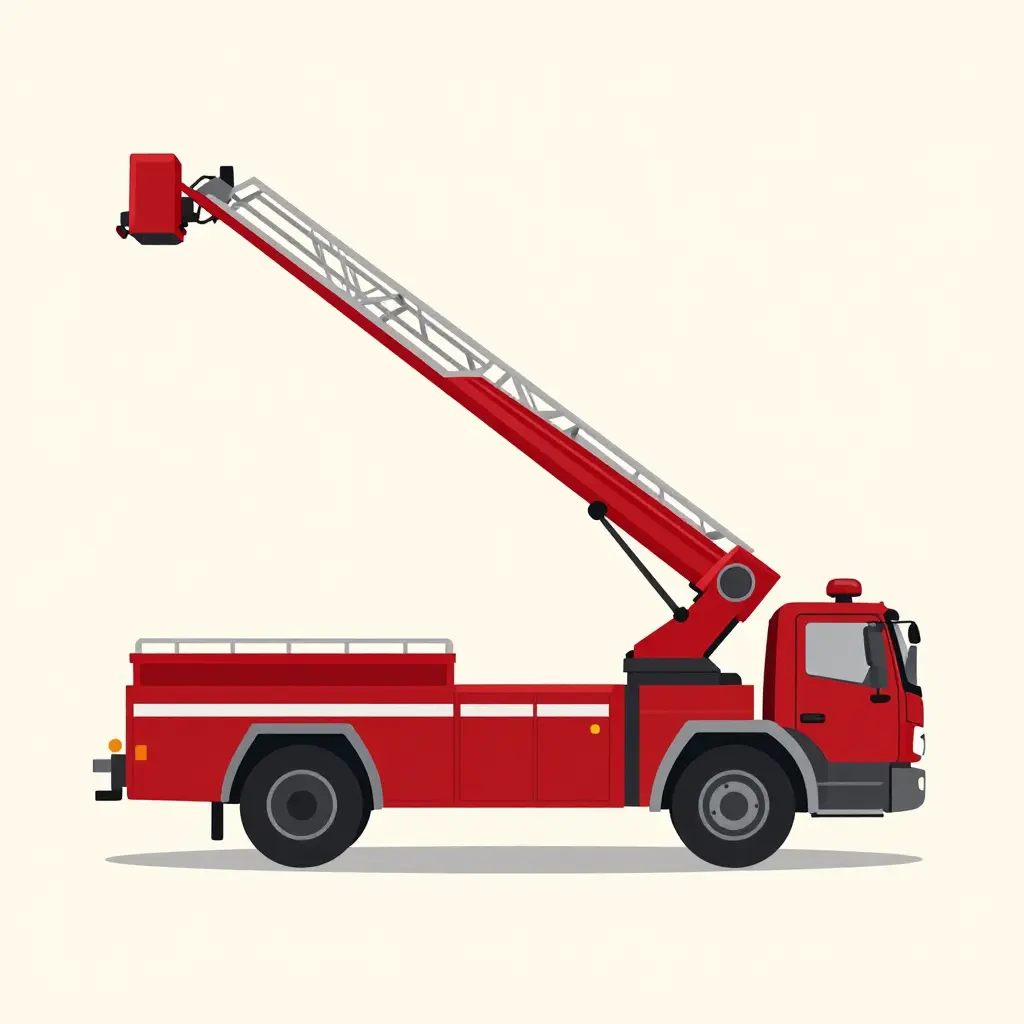
A brand-new aerial ladder truck typically runs $900,000 to $1.5 million or more, and tractor-drawn or 100-foot-plus configurations can climb past $2 million. That money buys current NFPA-compliant safety systems, a factory warranty, modern electronics, and a chassis built exactly to your spec.
Here is the catch: lead times. Departments now routinely wait three to five years for delivery, so you lock in today’s price for a truck that arrives in a future budget cycle. New makes sense when you need the newest capability and can absorb both the sticker shock and the wait.
Buying Used: Lower Upfront Cost, Higher Unknowns
A used aerial usually lands at 40 to 60 percent of the new price, or $350,000 to $900,000 depending on age, mileage, and aerial condition. The savings can free up capital for staffing, stations, or a second apparatus.
The trade-off is risk. Older trucks have less service life left, may lack current safety features, and can hide expensive surprises in the aerial boom, hydraulics, or pump. If you go this route, insist on a full third-party inspection. Many departments start by browsing listings such as these old fire truck for sale options to see what the market actually charges.
Refurbished or Remanufactured: The Balanced Middle Ground
Refurbishment falls between the two extremes, often landing in the $600,000 to $1.1 million range and adding roughly 10 to 15 years of service life. A quality reman rebuilds or replaces the engine, brakes, suspension, aerial, and electrical systems, which gives you a largely renewed truck on your existing or donor chassis.
You get most of the reliability of new at a real discount, and delivery is much faster, often within a year rather than several. That fits departments that want extended life without a full capital campaign. To compare spec’d-up options, review these ladder fire truck for sale listings and weigh factory-condition rigs against your reman quotes.
The Bottom Line
New buys warranty and the latest safety technology at the highest cost. Used cuts upfront spending and shifts risk to your maintenance team. Refurbished sits between the two, stretching dollars while keeping a capable aerial in service. Match the path to your timeline, your fleet age, and your tolerance for the unknown, and you’ll have a decision your council can defend.
Side-by-Side Comparison
| Factor | New | Used | Refurbished |
|---|---|---|---|
| Typical price range | $900K-$1.5M+ | $350K-$900K | $600K-$1.1M |
| Warranty | Full factory | Limited or none | Often limited on rebuilt systems |
| Safety features | Latest / current NFPA | May lag current standards | Upgradable to current standards |
| Lead time | 3-5 years | Weeks to months | Often under 1 year |
| Remaining service life | 20+ years | Varies / limited | Extended 10-15 years |
| Maintenance risk | Lowest | Highest | Moderate |
| Best for | Well-funded, long-horizon upgrades | Budget-tight, quick-gap needs | Stretched budgets needing long-term reliability |
The Real Budget: 10-Year Total Cost of Ownership
Procurement committees tend to fixate on the purchase order. The acquisition price is only the first line in a much longer ledger. Over a decade of front-line service, the recurring costs of owning and operating an aerial can rival or surpass the original invoice. Here is where the money actually goes after delivery:
- Fuel and routine maintenance – A heavier chassis, a thirsty diesel engine, and daily duty cycles mean constant fuel burn, plus oil, brakes, tires, and transmission service at every interval.
- NFPA testing and aerial inspections – Annual apparatus testing under NFPA 1911 and periodic aerial and ground-ladder load checks require certified technicians and take the truck out of service.
- Insurance – High-value, high-liability apparatus draws premium rates that climb as replacement costs rise across the industry.
- Technician training – Aerial-specific certifications, operator qualifications, and continuing education keep crews certified, at recurring tuition and backfill cost.
- Replacement parts and aerial certification – Proprietary hydraulic, electrical, and structural components, plus the 5-year structural and aerial re-certification, create predictable spikes you cannot avoid.
- Facility and garage modifications – Longer bays, taller doors, reinforced floors, and heating upgrades are often needed before the truck even arrives.
Taken together, these items make the upfront price a poor proxy for true affordability. If you want a capital budget you can defend, model a full 10-year total cost of ownership – purchase, operation, testing, and eventual replacement – rather than comparing sticker prices alone. To see how these line items fit into a wider spending plan, review our guide on fire truck expenses, budgeting, and safety.
What the Numbers Look Like Across Configurations
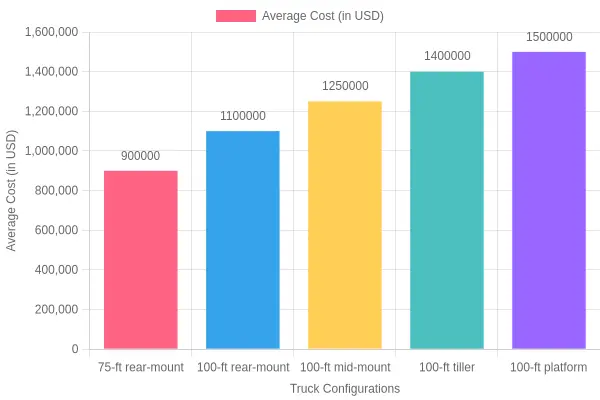
Aerial reach and mounting style are two of the biggest cost drivers in any municipal apparatus budget. The chart below breaks down the average purchase price of a new ladder truck across five popular configurations, giving city budget planners a realistic starting point.
| Configuration | Average New Cost |
|---|---|
| 75-ft rear-mount | $900,000 |
| 100-ft rear-mount | $1,100,000 |
| 100-ft mid-mount | $1,250,000 |
| 100-ft tiller | $1,400,000 |
| 100-ft platform | $1,500,000 |
Reading the Trend
As reach climbs from 75 feet to 100 feet and configurations get more complex, pricing moves in noticeable jumps rather than smooth increments. A mid-mount aerial adds engineering complexity and a lower travel height. A tiller needs a second driver station and a rear-steering setup. A platform (bucket) aerial carries the highest premium because of the rescue basket, waterway, and stabilization systems.
Match the spec to actual response needs instead of defaulting to the largest rig. If you are comparing models and pricing structures in more detail, our guide to ladder fire trucks for sale walks through how configuration choices translate into real sticker differences. Getting the reach-to-cost balance right up front keeps a capital plan realistic and defensible at budget hearings.
10-Year Total Cost of Ownership: Where Your Ladder Truck Budget Actually Goes
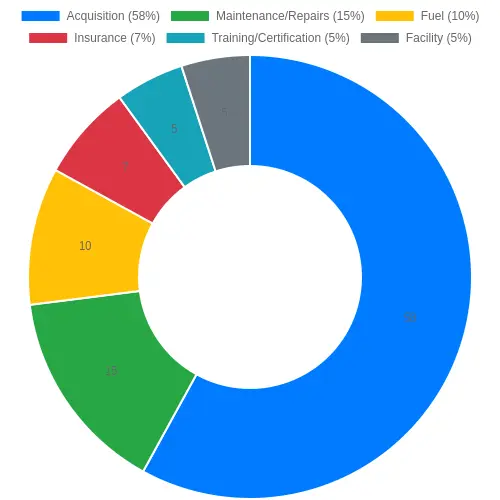
When a city council approves a ladder truck purchase, the sticker price usually dominates the conversation, but the real cost unfolds over a decade of service. The doughnut chart below breaks a typical 10-year total cost of ownership (TCO) into six core categories that add up to 100%, so budget planners can see where every dollar lands.
Reading the Chart at a Glance
| Category | Share of 10-Year TCO | What Drives It |
|---|---|---|
| Acquisition | 58% | Purchase price, apparatus specs, aerial device, financing interest |
| Maintenance & Repairs | 15% | Aerial inspections, pump service, brakes, tires, drivetrain |
| Fuel | 10% | Diesel consumption, idle time, emergency response cycles |
| Insurance | 7% | Liability coverage, replacement value, fleet-wide policy |
| Training & Certification | 5% | Aerial operator certification, recertification, drills |
| Facility | 5% | Bay storage, ventilation, heating, bay door maintenance |
Why the Acquisition Slice Dominates
Acquisition takes the majority of the 10-year pie. A new municipal ladder truck routinely carries a seven-figure price tag, and the aerial device, custom chassis, and pump package push it higher. For planners comparing options, the full purchase scope matters more than the headline figure. Our guide to how much a new fire truck costs breaks down the variables that shape the acquisition slice.
Cities get into trouble when they treat acquisition as the entire budget. It is not. The other 42% of TCO accumulates year after year, and overlooking it leads to underfunded maintenance accounts and deferred repairs.
The Hidden Weight of Ownership Costs
The 15% maintenance and repairs slice grows heavier with age. Aerial ladders require annual certification inspections, and hydraulic, electrical, and structural components wear with every call. Fuel, insurance, training, and facility costs each look modest on their own, but together they account for nearly half of what you spend after the truck arrives.
For city planners, the takeaway is simple: model the whole doughnut, not just the acquisition slice. Building these six categories into your capital and operating forecasts keeps a ladder truck response-ready for its full service life and prevents the budget surprises that derail fleet plans.
Frequently Asked Questions: Ladder Truck Costs for Municipal Fire Departments
How much does a ladder truck cost for a municipal fire department?
A new municipal ladder truck typically lands between $1.5 million and $2.7 million. Recent purchases confirm the range: Marietta, Ohio took delivery of a $1.7 million ladder truck in 2024, though the same rig would cost roughly $2 million to $2.5 million if ordered today. Berkeley, California budgeted about $2.23 million per tractor-drawn aerial, and Portsmouth and Orillia approved rigs at $2.5 million and $2.7 million respectively. The exact figure depends on the aerial length, chassis, and how much customization the department requests.
What is the cheapest way to buy a ladder truck?
Buying used is by far the most budget-friendly route. Older used ladder trucks often start around $50,000 to $100,000, while modern 75- to 100-foot-plus aerials generally begin near $200,000 and climb upward. A 2020 Pierce Arrow XT 107-foot aerial has listed around $950,000, still less than half the price of a comparable new build. You will still need to budget for an aerial certification, pump testing, and possible refurbishment before the rig enters frontline service.
How long does a ladder truck last?
Most municipal ladder trucks serve roughly 20 to 25 years when properly maintained. Departments commonly run a rig as a frontline unit for the first 10 to 15 years, then shift it to reserve status, which is exactly why mid-life refurbishments and strict maintenance schedules are worth the investment.
What drives aerial ladder truck price the most?
Four factors dominate: aerial type and length (mid-mount, rear-mount, or tiller), custom vs. stock construction, the chassis and powertrain, and market backlogs. Nearly all aerials are now built fully custom, and production backlogs at the small number of North American manufacturers have pushed pricing and delivery times steadily higher.
How long does it take to receive a new ladder truck?
Longer than most budget planners expect. Connecticut departments have reported waits of up to four years, and Portsmouth and Orillia placed orders for trucks scheduled to arrive in 2030. Every purchase cycle should begin years before the rig is actually needed.
The Bottom Line: Plan Early, Budget Realistically
That rising price tag we opened with – a ladder truck that cost $1.7 million just a few years ago now commanding up to $2.5 million – is the single most important takeaway for public safety officials and city budget planners. Ladder truck cost is not a one-time line item; it is a decades-long commitment covering procurement, maintenance, refurbishment, and eventual replacement. The departments that handle it well start planning three to four years in advance, weigh new versus used options honestly, and lock in pricing before the next escalation hits. Whether you are modernizing your fleet or buying your very first aerial, take time to explore reliable Zoomlion fire trucks, compare current fire trucks for sale, and get a clear picture of overall fire truck price trends. With real numbers and a multi-year roadmap, your municipality can secure the right apparatus without breaking the budget.