
China 6×6 Fire Truck Selection: Axle Load and Climbing Gaps That Surface on the First Off-Road Run
Why a China 6×6 Fire Truck Must Be Evaluated Before It Leaves the Yard
A China 6×6 fire truck is a firefighting vehicle on a three-axle chassis with all six wheels driven. On unpaved ground that layout spreads load and finds traction a 4×4 or 6×4 cannot match. Two variables decide most of the outcome, and neither shows up on a glossy spec sheet: how the load splits across the axles, and how the truck climbs once its tanks are full.
Axle load distribution decides whether the truck stays stable and road-legal. Climbing performance decides whether it reaches the fire. Both are easy to underestimate on paper and expensive to fix after delivery. The failures show up the first time a loaded truck rolls onto soft ground or a steep ramp: a front axle over its limit, weight sitting in the wrong place, tires that cannot hold, or a gradeability figure that assumed a lighter build. Checking fire truck chassis specifications at the specification stage costs far less than rebuilding a delivered unit.
Two categories of gap need checking before sign-off:
- Axle load gaps – overloading on a single axle, an off-target center of gravity, and bridge ratings that are not compliant under full payload.
- Climbing gaps – gradeability that fails once water and foam are loaded, plus traction control and torque mismatches.
Why 6×6 Fire Trucks Dominate Off-Road Firefighting
When a wildfire, mine site, or remote plant needs suppression, the terrain usually decides which truck arrives. Three driven axles keep power, weight and grip working together on ground that is soft, steep or uneven.
The three-axle drivetrain
A 6×6 sends engine torque to three axles, one front and two rear, so all six wheels can pull at once; if one wheel lifts off the ground, the others keep the truck moving. The difference from a highway 6×4 is that layout. A 6×4 drives only the rear tandem and leaves the front axle to steer.
Torque distribution and traction
The transfer case and inter-axle differentials divide torque between axles, and a cross-axle lock does the same for the two wheels on an axle. Locking them stops one spinning wheel from taking torque the others could use. On loose gravel, mud and gradients that would stall a lighter chassis, that is often the difference between moving and digging in.
How the third axle changes weight distribution
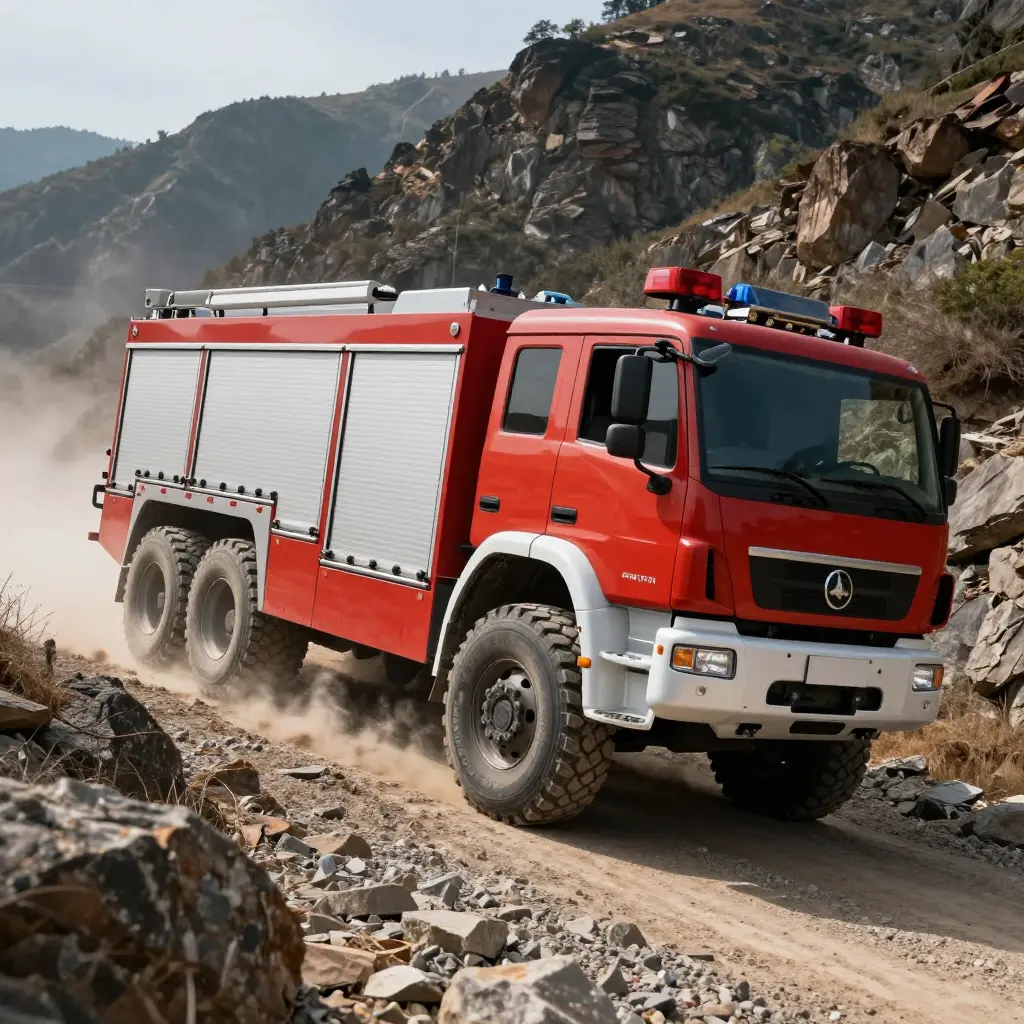
A third axle also changes where the load sits. Spreading the tank, pump and equipment mass over three axles keeps each one inside its own limit, and that matters because a Gross Vehicle Weight Rating (GVWR) is only useful if no single axle is overloaded. A truck can sit comfortably under its GVWR on paper and still fail an off-road run because one axle is carrying too much.
| Configuration | Driven Axles | Steering Axles | Weight Spread | Typical Strength |
|---|---|---|---|---|
| 4×4 | 2 (front + rear) | 1 | Concentrated on two axles | Light and nimble, limited payload |
| 6×4 | 2 (rear tandem) | 1 | Rear-biased | Good road payload, weak off-road grip |
| 6×6 | 3 (front + rear tandem) | 1 | Evenly spread over three axles | Maximum traction and payload on rough ground |
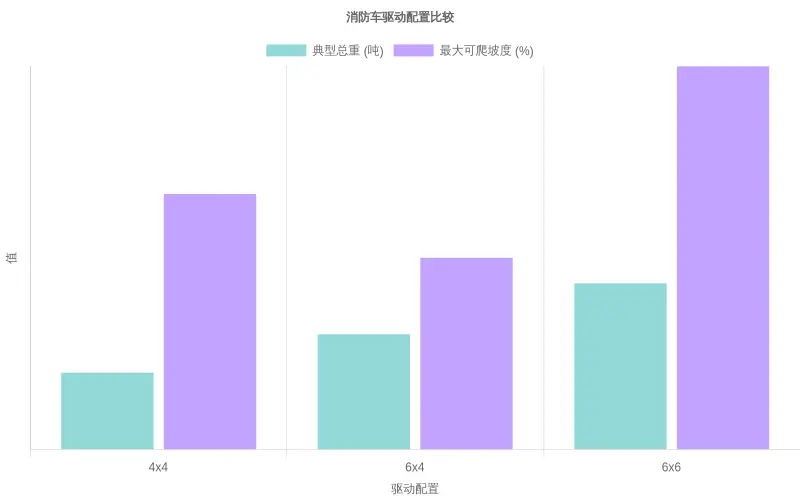
A 6×6 usually carries a higher GVWR and climbs steeper grades than a 4×4 or a 6×4, because more driven axles put more traction on the ground.
Zoomlion Fire Truck has built these chassis for more than 30 years, across a lineup that runs from compact 4×4 units to heavy 6×6 and airport platforms, with each build matched to axle load limits and terrain. Buyers who understand the heavy-duty fire truck chassis behind each configuration can match GVWR, axle capacity and gradeability to the mission instead of finding the gap on the first off-road run.
Axle Load Gaps: The First Thing That Breaks the Off-Road Run
A 6×6 chassis looks nearly indestructible on paper. The first rutted track usually disagrees, and the problem is rarely the engine, the transfer case or the tire tread. It is an axle load problem the spec sheet never tested, invisible until the truck left pavement.
Every build starts from tare weight, the empty truck leaving the shop. Tanks, pumps and equipment then set the payload distribution across three axles, and the split is rarely even.
How the three axles actually share the weight
- Front axle: carries the cab, engine and often a front-mounted pump or winch. On a tanker it is usually the lightest of the three, until a heavy pump pack or winch is mounted forward.
- Middle axle: is the pivot. Long water and foam tanks straddle it, so a full tank can push it toward its rated limit while the front axle floats.
- Rear axle: absorbs the tail of the tanks and the rear compartments. On an aerial platform it also carries the turntable, boom and outrigger loads, heavy mass sitting high and far back.
That mismatch is the axle load gap: the difference between an axle’s rating and what it actually carries when the truck is full. Asphalt hides it. Off-road, articulation, body roll and grade changes swing weight from axle to axle, and the gap turns into broken hardware.
What happens when you exceed a per-axle limit
- Tire overload: excess axle load heats the tires, speeds up sidewall fatigue and turns a routine climb into a blowout risk.
- Reduced braking stability: an over- or under-loaded axle changes how the truck pitches under braking, lengthening stops and inviting a jackknife on loose ground.
- Differential and driveline wear: inter-axle torque fighting mismatched wheel loads chews through differentials and driveshafts long before the odometer suggests it should.
- Regulatory non-compliance: bridge formulas, road limits and per-axle certifications are checked axle by axle, not only in total.
This is how GVWR compliance misleads. A truck can sit comfortably under its Gross Vehicle Weight Rating and still be illegal and unsafe because one axle is past its own limit. Total weight is the headline; per-axle weight is the fine print that grounds the truck. Buyers who plan around fire truck safety and budgeting weigh each axle, not just the vehicle.
Why the gap shows up on the very first off-road run
Axle load gaps surface on day one off-road because that is the first time the truck leaves the level, static world of the spec sheet. On pavement the load split stays close to what the design calculator predicted, so a hidden imbalance never reveals itself. The moment the chassis articulates, climbs and leans, axle load transfers between axles, and whichever axle was already near its ceiling at tare-plus-payload tips into overload. The gap was always there; off-road driving just stops hiding it.
China 6×6 Fire Truck Axle Load Specifications
Every 6×6 platform balances its rated payload against its weakest axle, so the ratings below have to be matched to the water, foam and equipment the truck will actually carry. Buyers weighing chassis limits can review fire truck chassis and axle load options before committing to a build.
| Configuration | GVWR (t) | Front Axle Load Rating (t) | Rear/Middle Axle Load Rating (t) | Tank Capacity (L) | Typical Firefighting Role |
|---|---|---|---|---|---|
| 6×6 Water Tanker | 33 | 9 | 2 x 13 | 12,000-18,000 | Bulk water shuttle |
| 6×6 Pumper | 26 | 8 | 2 x 11 | 4,000-6,000 | Structural fire attack |
| 6×6 Aerial Platform | 33 | 9 | 2 x 13 | 3,000-5,000 | Elevated rescue / water tower |
| 6×6 Airport Rescue (ARFF) | 39 | 10 | 2 x 14 | 10,000-13,000 | Aircraft crash rescue |
| 6×6 Foam Tender | 26 | 8 | 2 x 11 | 6,000 (foam/water) | Industrial / hazmat |
| Highest axle-load-gap risk (full tank) | 33-39 | 9-10 | 2 x 13-14 | Full tank at max | Heavy tanker + ARFF loaded |
Climbing Gaps That Surfaced on the First Off-Road Run
Spec sheets like a clean number. The first off-road run rarely agrees.
When a China 6×6 fire truck leaves the paved apron for a gravel access track or a rain-soaked embankment, the distance between the rated climbing grade and the grade it can actually hold becomes obvious. Those shortfalls are the climbing gaps, and they are cheaper to settle before a contract is signed than after the truck is fully loaded and pointing uphill.
The physics behind gradeability
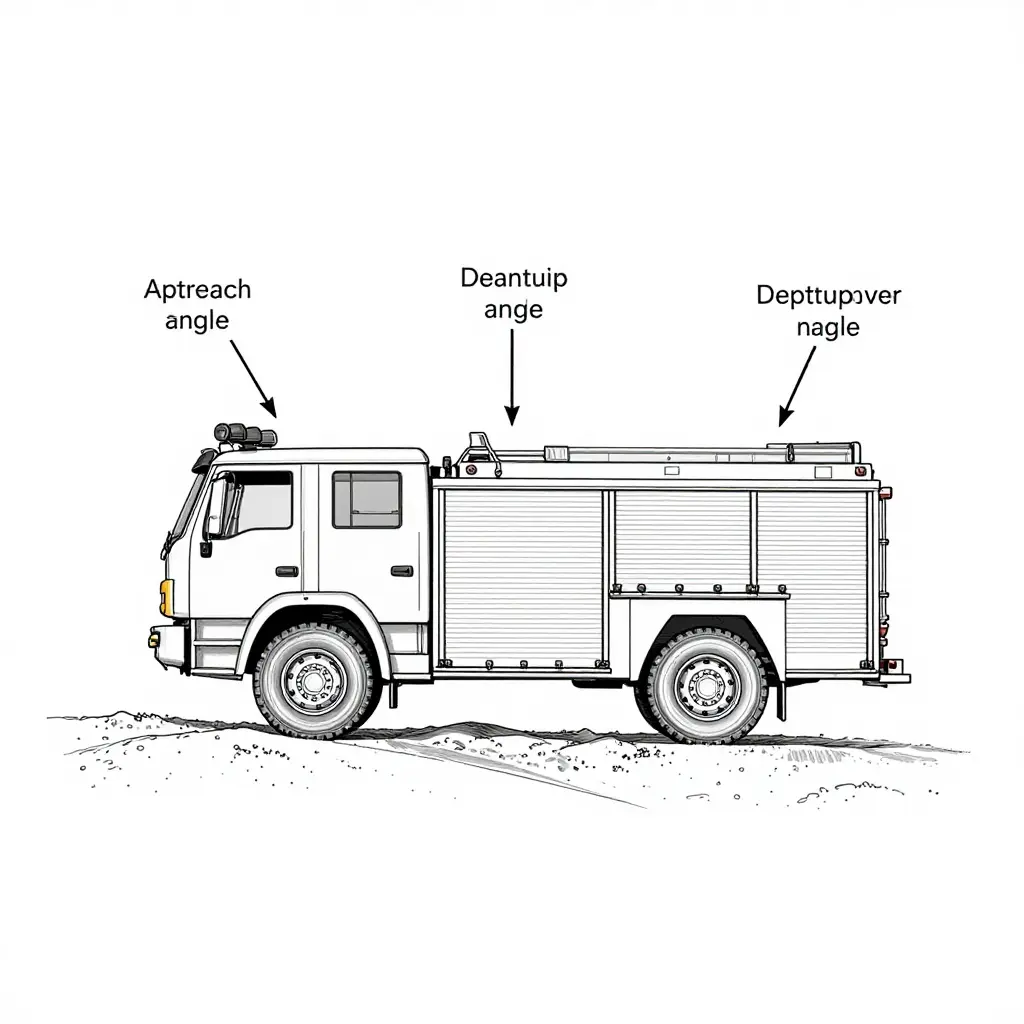
Gradeability is the steepest slope a vehicle can climb, usually given as a percentage: a 30% grade rises 30 units for every 100 units of travel. It is limited by three geometry angles and one grip limit:
- Approach angle – the steepest ramp the front tires can meet without the bumper or front overhang striking the ground.
- Departure angle – the steepest decline the rear overhang can leave without scraping.
- Ramp breakover angle – the crest angle between the front and rear axles; a long wheelbase or low belly pan can leave the chassis stranded on its center.
- Traction limits – how much grip the tires can convert into forward force, governed by the traction coefficient (the friction between rubber and surface). Wet grass and loose gravel cut this coefficient sharply, so the geometry may allow a climb the tires cannot hold.
Tire pressure is the main adjustment. Lowering it enlarges the contact patch and raises grip on soft ground, at the cost of ground clearance and higher rolling resistance.
Why the third axle matters more than expected
A heavily loaded third axle adds payload capacity, but it also moves weight rearward and raises the cost of wheel slip. On a 6×6 the trailing axle often carries a large share of gross weight. When one wheel on loose ground loses grip, an open differential sends torque to the spinning wheel and the truck stalls even though the other five tires still have traction. The more weight the third axle carries, the deeper it digs and the more it shears the surface, which cuts the effective traction coefficient just when it is needed most.
Rated grade vs achievable grade under full payload
Rated grade is usually measured on a dry, hard test surface at a favorable load. Real duty is different: achievable grade falls under full payload as soon as the surface turns loose, wet or rutted.
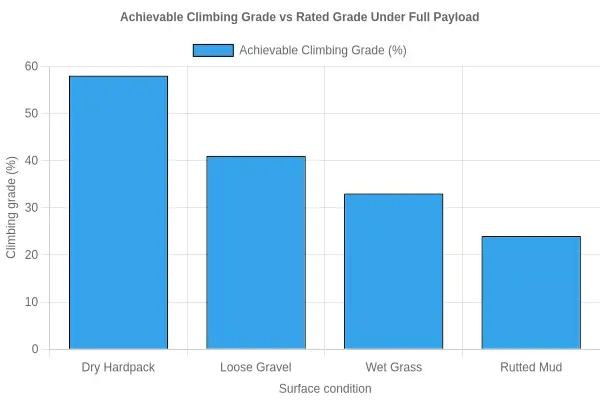
| Surface condition | Traction coefficient (approx.) | Achievable grade (full payload) |
|---|---|---|
| Dry hardpack | 0.80 | 58% |
| Loose gravel | 0.55 | 41% |
| Wet grass | 0.40 | 33% |
| Rutted mud | 0.30 | 24% |
A truck rated at 60% on a dry surface may manage only about 40% of that in rutted mud, a climbing gap of more than 35 percentage points. Spec numbers on their own are a poor guide; compare them against the load and terrain you expect.
If the mission is tight urban response rather than steep terrain, the spec question becomes pumper fire truck selection, where pump flow, tank size and axle loading interact. Aerial units have a vertical limit of their own, covered in working height gaps.
Climbing gaps start with axle load distribution
Every climbing gap comes back to axle load distribution. Load the front axle too lightly and the steering tires lose grip on the climb; overload the rear or third axle and those tires dig in, spin and drag the truck backward. The rated grade is a brochure number; the achievable grade is the result of how the load is balanced. Get the distribution right across all three axles and the truck climbs close to what was promised. Get it wrong and no amount of engine torque closes the gap.
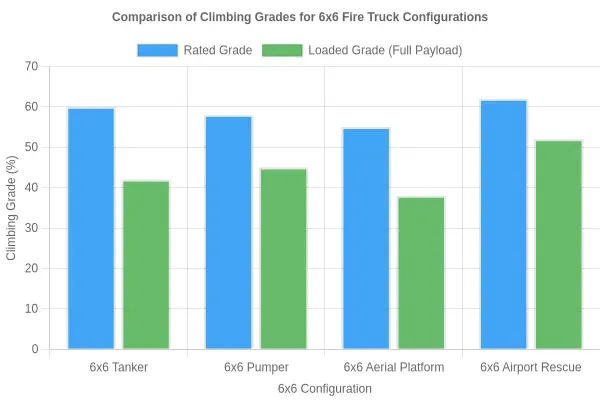
Comparing Rated vs. Loaded Climbing Grades
The chart above plots rated grade against achievable grade under full payload for four common 6×6 configurations. The light-blue bars are the factory figure; the green bars are what the truck can climb with tank, water, foam and equipment at maximum. Watch the distance between them. A wider climbing gap means a higher risk of stalling or losing traction on the first off-road run, which is the moment a loaded rig leaves the paved apron.
| 6×6 Configuration | Rated Grade (%) | Loaded Grade (Full Payload) (%) | Climbing Gap (%) |
|---|---|---|---|
| 6×6 Tanker | 60 | 42 | 18 |
| 6×6 Pumper | 58 | 45 | 13 |
| 6×6 Aerial Platform | 55 | 38 | 17 |
| 6×6 Airport Rescue | 62 | 52 | 10 |
The tanker and aerial platform lose the most capability once payload is added. The airport rescue configuration holds the tightest gap, which fits its higher power-to-weight ratio and purpose-built chassis. If you are still weighing chassis and configuration, it is worth reviewing how climbing gaps and axle load interact during fire truck selection before fixing a specification.
6×6 Fire Truck Selection Checklist for Off-Road Readiness
A disciplined 6×6 fire truck selection process separates chassis that survive the first muddy grade from those that bog down or overheat. Verify these ten points with the manufacturer, and ask for documented figures rather than brochure claims.
- Per-axle load ratings: Confirm each of the three axles is rated above its actual service load. A rear tandem over its limit is the fastest route to cracked springs and failed bearings.
- GVWR margin: Ask for at least a 10-15% buffer between the loaded gross vehicle weight and your real water-plus-equipment total, so crew, tools and unforeseen payload still fit.
- Axle load gap tolerance: Check how evenly load distributes across the three axles, because a large front-to-rear gap means poor weight balance that costs traction and steering on soft ground.
- Rated vs loaded gradeability: Compare the climbing angle quoted for an empty chassis with the grade it holds when the tank is full, since advertised figures often assume a stripped truck.
- Tire specification and pressure systems: Verify off-road tire ply ratings and tread pattern, and whether a central tire inflation system is fitted to adjust pressure for sand, mud or rock.
- Differential lock configuration: Establish which axles offer locking or limited-slip differentials and whether the locks engage independently. Cross-axle locking is what turns wheelspin into forward motion.
- Approach, departure, and breakover angles: Measure all three clearance angles for your worst-case route, because a low-hanging tank or bumper grounds out long before the drivetrain runs out of grip.
- Tank and payload placement: Inspect where the water tank, pump and equipment sit relative to the axles. Central, low mounting keeps the center of gravity down and holds stability on side slopes.
- Frame and suspension uprating: Confirm the chassis frame and leaf or air suspension are rated for continuous off-road duty, not intermittent paved-road use.
- Service and parts access: Ask how quickly axles, differentials and transfer cases can be serviced in the field. Remote operations reward designs a local mechanic can repair.
Run these checks alongside a well-planned custom fire truck build, and a department can specify axle ratings, gearing and tank placement around the terrain it actually faces instead of a generic template.
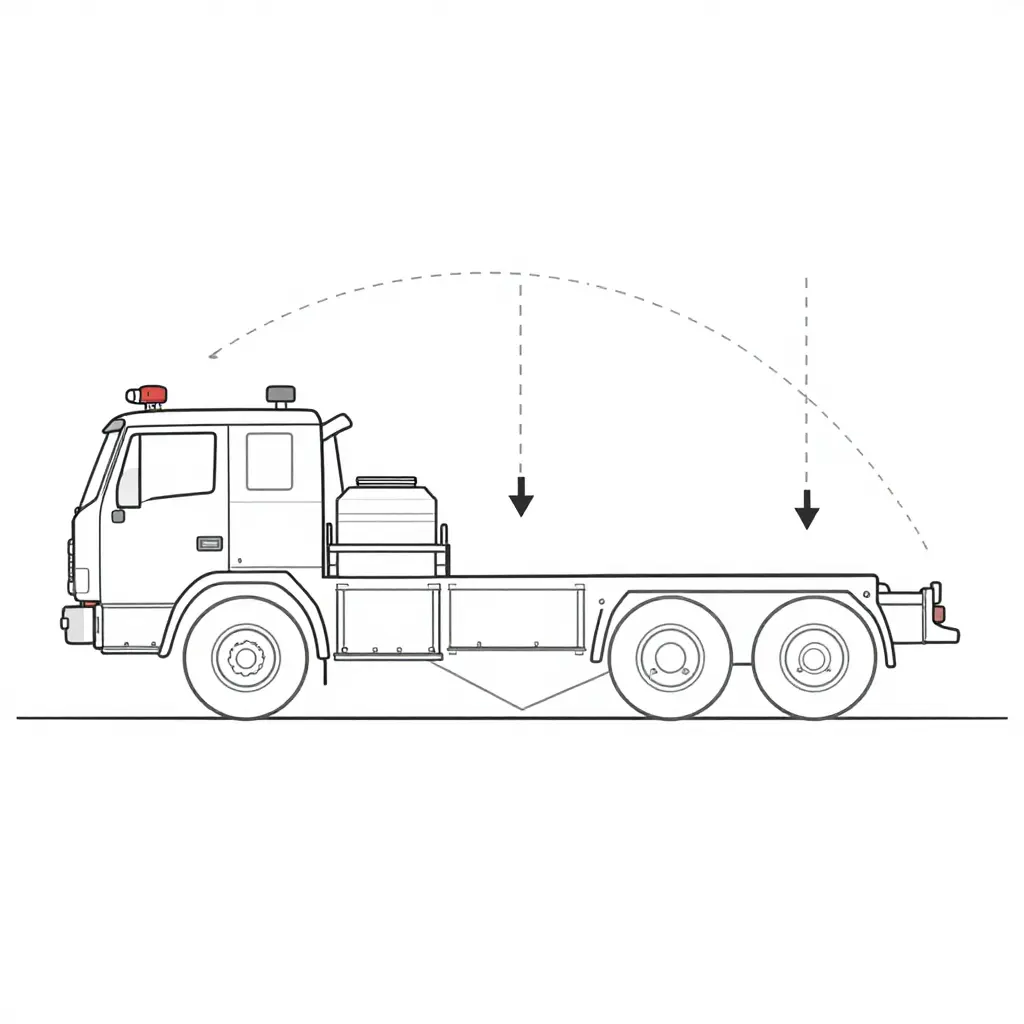
Figure 1. A 6×6 fire truck chassis in side view, showing how weight is distributed across the front, middle and rear axles and how the approach, departure and breakover angles set what the truck can clear off-road.
How to Close Axle Load and Climbing Gaps Before Delivery
Axle load and climbing gaps rarely announce themselves on the spec sheet. They show up on the first steep grade, when the front axle unloads, the rear tires dig in and the crew finds the truck cannot hold its line. Closing them is engineering and procurement work, not a last-minute fix.
Start with weight placement
Move the tank and heavy equipment before you move the axles. Shifting a water tank a few hundred millimeters forward or aft changes the load on each axle and the traction available on loose or inclined ground. On a China 6×6 platform the goal is to keep weight centered so all three axles share it, rather than overloading the rear and starving the front.
Select axle ratings with margin
Specify axle ratings above the calculated laden weight, not exactly at it. A rating that matches the dry weight leaves nothing for water, foam, tools and crew. Choosing between compliant configurations is one of the fire truck cost factors buyers weigh during procurement.
Specify tire pressure control and differential locks
A central tire inflation system lets the driver lower pressure for soft ground and restore it for road transit. Differential locks front, center and rear keep torque going to the wheels that still have grip when one axle starts to spin.
Steps to settle before signing off:
- Recompute axle load with the tank full and all equipment mounted
- Confirm each axle rating carries a defined safety margin
- Install and calibrate a tire pressure control system
- Verify differential lock sequencing for all three axles
- Run a controlled off-road verification on representative grades and surfaces
Validate on a controlled off-road run
A controlled run on grades and surfaces that match the deployment terrain brings problems up while they are still fixable. Compare measured axle loads with the design targets, then adjust placement or ratings.
Working with an experienced fire truck manufacturers partner such as ZOOMLION, which has spent more than 30 years on diversified fire-fighting vehicle design, reduces post-delivery surprises. Axle load, climbing and traction gaps get engineered out before the keys change hands instead of surfacing on the first call.
Frequently Asked Questions About China 6×6 Fire Truck Selection
Specifying a China 6×6 fire truck is rarely a matter of ticking boxes. The hard part comes once the build is finished and the rig rolls onto loose ground. These are the questions buyers ask most often.
What is an axle load gap?
An axle load gap is the difference between an axle’s rated capacity and the load it carries once the body, water tank, pump and equipment are installed. An axle rated at 13 tonnes may end up carrying 15 after upfitting. That distance between the rating plate and the real load is what turns a compliant design into an overloaded one.
Why do climbing gaps only appear on the first off-road run?
Pavement hides weaknesses in traction and torque. The first off-road climb loads the drivetrain fully: soft soil raises rolling resistance, weight transfers to the rear axle and the tractive effort required peaks. Low axle ratings, poor weight distribution and under-spec tires that stayed dormant on the road pick that moment to show up.
How do I verify per-axle compliance?
Weigh the completed truck on a certified bridge with the tank full and crew and equipment aboard. Record each axle position separately and compare the numbers with the chassis load ratings. Keep a written weight record and re-check it after any major modification. A chassis with documented axle ratings makes this easier; see this guide to fire truck chassis selection for the ratings to prioritize.
Is a 6×6 always better than a 6×4 off-road?
No. A 6×6 drives the front axle as well, which helps on soft or steep ground, but it adds weight, cost and maintenance. Where the service area is paved or gently graded, a properly rated 6×4 is lighter, cheaper to run and just as capable. Choose 6×6 when sustained loose-surface traction is genuinely part of the job.
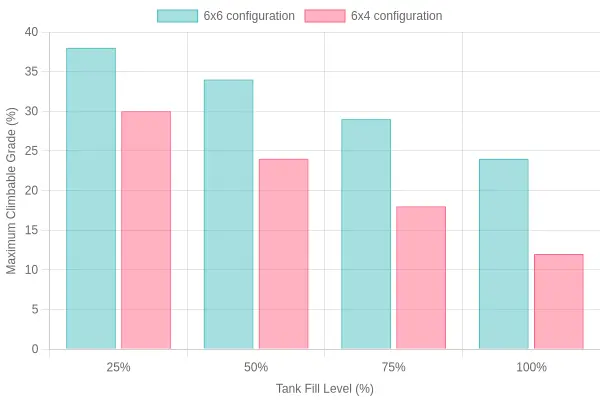
How does tank capacity affect gradeability?
Water is heavy, roughly 1 kg per liter, and every extra liter loads the axles and shifts the center of gravity. A larger tank can shave several percentage points off climbable grade, especially on a 6×4. The chart below shows gradeability falling as the tank fills.
How do I choose axle ratings with a safe margin?
Match or exceed the calculated axle load, then add a 15-20% buffer for terrain, dynamic loading and future equipment. Confirm gross vehicle weight stays within legal limits, check that tire load ratings match the axle loads, and confirm the drivetrain can transmit the torque a loaded 6×6 asks of it. Margin is not wasted capacity; it is what keeps the rig climbing instead of failing inspection.
Key Takeaways for 6×6 Fire Truck Buyers
Two gaps decide whether a China 6×6 fire truck does its job: axle load and climbing capability. Neither is clear on a spec sheet, and both show up on the first off-road run, when a loaded apparatus meets soft ground, loose surfaces and steep grades. Buyers who test both against real operating conditions avoid expensive modifications after delivery.
- Check axle load ratings against the fully equipped, fully loaded apparatus, not the base chassis figure.
- Test climbing on the gradients and surfaces the truck will actually face, loaded with water, equipment and crew.
- Match drivetrain and body to the mission, whether that is a fire truck for sale for general pumper duty or a specialized ladder fire truck for sale for aerial work.
- Settle specifications with the manufacturer before purchase, so the delivered vehicle matches the terrain it will work on.
ZOOMLION has manufactured fire trucks in China for more than 30 years, supplying aerial-platform and aerial-ladder units to fire services and B2B clients worldwide. Its engineering teams design climbing and axle-load performance into each platform from the start rather than correcting it after delivery.